
Concrete Repair Monroe NC: Fix vs. Replace Decision Guide
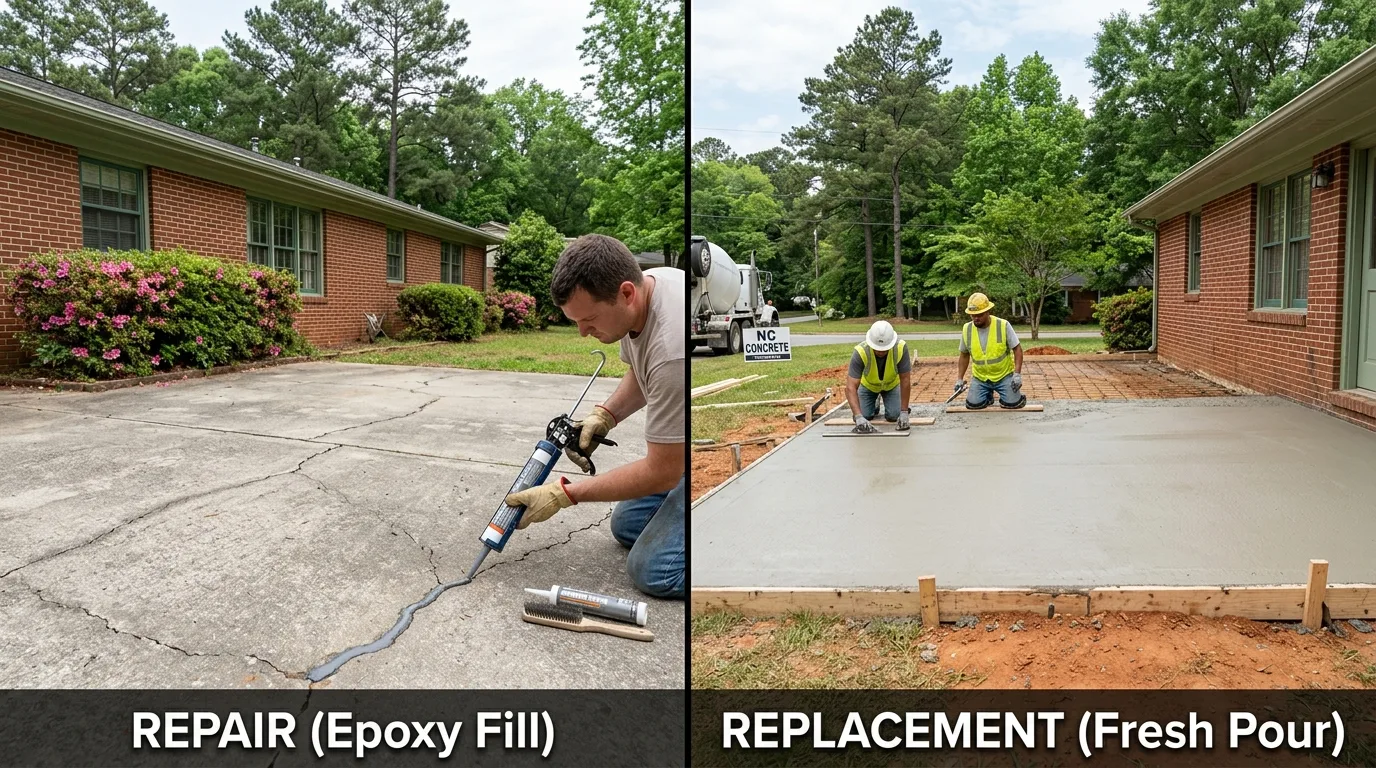
After the first significant crack appears in a Monroe driveway or patio, most homeowners ask the same question: repair or replace? The answer depends on what caused the damage — not just how it looks. A surface crack that formed during curing is categorically different from a crack that appeared because Monroe’s red clay moved beneath the slab. Treating both the same way produces either unnecessary expense (replacing something repairable) or recurring failure (repairing something that will just crack again).
Get an Honest Monroe Concrete Assessment
Monroe Concrete Contractors provides free repair vs. replacement assessments for all Union County concrete projects. Call (888) 376-0955.
The First Question: Is the Cause Still Active?
Before any Monroe concrete repair decision, the most important question is whether the cause of damage is still active or has stabilized. This single factor determines whether repair will hold long-term.
Dormant causes (repair can work):
- Normal concrete shrinkage cracking during original cure — typically hairline, uniform, and doesn’t change with seasons
- Settlement from original loose fill that has since compacted
- One-time impact damage (vehicle edge impact, tree fall)
- Surface scaling from a single de-icing salt event on concrete that wasn’t properly sealed
Active causes (repair will fail without addressing the root cause):
- Monroe’s expansive clay cycling through wet/dry seasons — cracks that open in spring and close in summer
- Tree roots growing under the slab and creating recurring heave
- Subsurface voids from utility erosion or organic decay beneath the slab
- Ongoing drainage failure concentrating water against the slab edge
A concrete repair applied over an active cause is temporary — Monroe homeowners in South Monroe neighborhoods with established tree canopies often experience exactly this cycle: crack, repair, crack again within two years. The repair isn’t failing; the root cause wasn’t addressed.
Repair-vs.-Replace Decision by Damage Type
Hairline surface cracks (under 1/8 inch): Repair almost always appropriate. Fill with a quality polyurethane or epoxy crack filler designed for horizontal concrete surfaces. Seal after repair. Monitor through two full seasonal cycles in Monroe (summer drought and winter/spring wet) to confirm stability.
Wider cracks (1/8–1/2 inch) with stable edges: Repair appropriate if edges are level and damage is isolated. Routing the crack to uniform width before filling ensures better adhesion for crack filler.
Cracks with vertical displacement (one side higher than the other): Indicates sub-base void or differential clay movement. Concrete leveling (mudjacking or polyurethane foam injection) can address the void; repair the crack surface afterward. If the displacement is more than 1 inch, or if multiple sections are displaced, evaluate whether the slab can be leveled reliably before committing.
Large areas of spalling (surface deteriorating and flaking): Surface restoration overlays can address spalling if the base concrete is structurally sound. An overlay bonds to the existing slab — first test that the slab passes a bond test (no delamination when struck with a hammer). If more than 30% of the surface is actively spalling, replacement is typically more cost-effective.
Full-depth cracks with active movement: Replace the affected section. A full-depth crack that opens and closes seasonally is a broken slab — no surface patch holds reliably over Monroe’s active clay.
Concrete Assessment for Monroe Homeowners
We inspect, evaluate cause, and recommend repair vs. replacement honestly — no upsell. Call Monroe Concrete Contractors at (888) 376-0955.
Cost Comparison: Repair vs. Replace in Monroe
Understanding the cost spread helps Monroe homeowners make a financially rational decision:
Crack repair (per crack): $50–$300 for DIY with quality materials; $200–$800 for professional injection repair depending on length and access
Concrete leveling (per panel): $100–$400 per panel for polyurethane foam injection; $150–$500 for mudjacking, depending on void size
Partial section replacement (per section): $500–$2,500 for a standard driveway panel or patio section, including demolition and haul-away
Full driveway replacement: $2,250–$6,750 for a standard two-car Monroe driveway (plain concrete) — see our Monroe concrete driveway cost guide for full pricing
The repair-vs.-replace calculation should include durability expectations: if the slab has another 10+ years of serviceable life with repair, the cost justifies it. If the slab is at end-of-life (40+ years old on Monroe’s clay, structural cracks throughout, significant sub-base failure), replacement avoids the compounding cost of recurring repairs.
Monroe-Specific Factors That Affect the Decision
Age of concrete: Monroe residential concrete from the 1970s–1980s was typically installed to thinner specs (3-inch slabs were common) and with less attention to sub-base depth than modern practice. Concrete from this era that’s cracking throughout may be at genuine end of useful life — repair extends it temporarily, not permanently.
Current sub-base condition: If the clay sub-base has been compromised — soft spots, voids, or saturated zones — surface repair without addressing the sub-base has a short lifespan. A Monroe contractor can probe the sub-base with a steel rod at crack locations to identify soft zones before recommending repair vs. replace.
Drainage changes since installation: Many Monroe driveways and patios that are now failing were originally installed with adequate drainage, which has since been disrupted by landscaping, additions, or grade changes from neighboring construction. Correcting drainage before repairing or replacing concrete is essential — otherwise the replacement fails on the same timeline.
Frequently Asked Questions
Can concrete cracks in Monroe be permanently repaired?
Cracks from dormant causes (original shrinkage, one-time settlement) can be permanently repaired with quality materials. Cracks from active causes (clay movement, tree roots, ongoing drainage failure) will recur unless the root cause is resolved first. The key diagnostic question for Monroe homeowners: does the crack change width or displacement seasonally? If yes, the cause is active and surface repair alone won’t hold.
Is mudjacking or polyurethane foam better for Monroe slab leveling?
Both can work for void-filling under Monroe slabs. Polyurethane foam cures faster (2 hours vs. 1 day for mudjacking), is lighter (which matters if the sub-base is already compromised), and can fill smaller voids more completely. Mudjacking uses a cement-soil slurry that is heavier but costs less. For Monroe’s residential applications, polyurethane foam leveling is generally preferred for isolated section raising; mudjacking is occasionally used for large commercial slabs where foam volume becomes cost-prohibitive.
How do I know if my Monroe concrete needs replacement instead of repair?
Replacement is the right answer when: the slab has full-depth cracks throughout more than 40% of the area, vertical displacement exceeds 1 inch across multiple sections, the sub-base is soft or voided in more than one area, or the concrete age and original spec make the remaining useful life short even with repair. A Monroe concrete contractor familiar with Union County’s clay conditions can usually make this call after a site visit.
Free Monroe Concrete Assessment — Repair or Replace?
Monroe Concrete Contractors gives you an honest recommendation backed by a free site inspection. Call (888) 376-0955 today.
Related: