
Monroe NC Red Clay Soil and Concrete: Homeowner's Guide
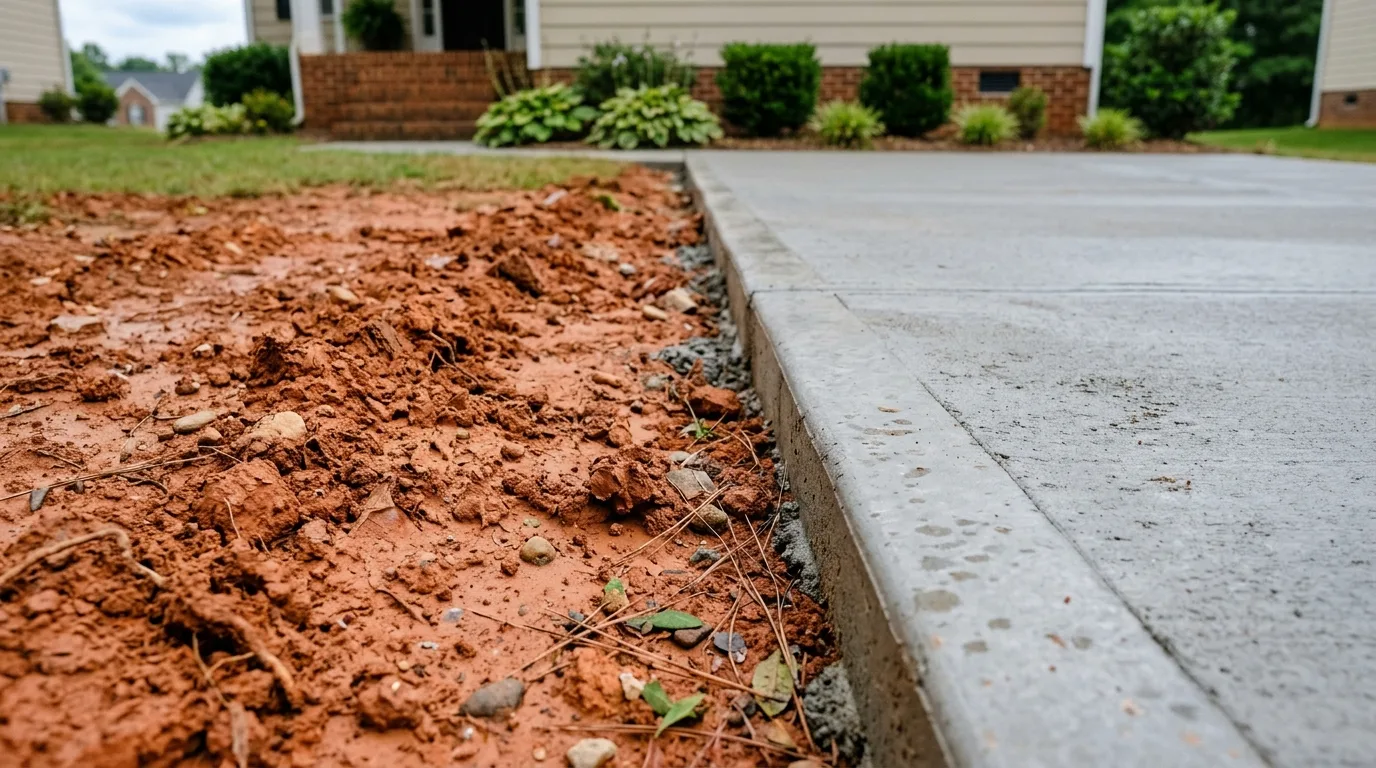
The expansive Piedmont red clay that underlies Monroe and all of Union County is the single biggest variable in local concrete performance — and the factor most often left unexplained to homeowners getting concrete estimates. When Monroe homeowners ask why a driveway cracked or a patio heaved after just a few years, the answer almost always traces back to how (or whether) the contractor addressed the clay sub-base.
Concrete Built for Monroe's Red Clay Soil
Monroe Concrete Contractors engineers every project for Union County's expansive Piedmont clay. Free estimates. Call (888) 376-0955.
What Makes Monroe’s Soil Different
Union County sits in the Piedmont physiographic region of North Carolina, where centuries of weathered granite and metamorphic rock have produced some of the most expansive clay soils in the Southeast. The dominant soil type in and around Monroe — the Cecil-Appling-Pacolet series — is classified by soil scientists as a highly plastic, expansive clay with a Plasticity Index (PI) that can reach 30–45 in the most active zones.
What that means for homeowners: this clay shrinks significantly when it dries out (Monroe’s summer droughts can pull 6–8% moisture out of the upper soil horizon) and swells when wet (winter rains and spring storms saturate the same zone). The seasonal cycle produces soil movement at the surface that can range from 1–3 inches of vertical displacement over a year — enough to lift and crack concrete slabs that aren’t properly isolated from soil movement.
The Western Monroe corridor and South Monroe neighborhoods built on undisturbed red clay tend to show consistent (if manageable) soil movement. Areas near Northeast Monroe where construction fill was placed over native clay in mid-century development can show more erratic movement because fill compaction was inconsistent by today’s standards.
How Red Clay Causes Concrete Problems in Monroe
Three mechanisms connect Monroe’s clay soil to concrete failures:
Volume change cracking: When clay dries under a slab — either through drought, tree root moisture extraction, or the drying effect of the slab itself — the shrinking soil creates a void beneath the concrete. Concrete is strong in compression but weak in tension; when the support disappears, slabs crack at the weakest point: typically corners, control joints, and midspan.
Heave cracking: When saturated clay swells under a slab — common in Monroe’s spring wet season — upward pressure lifts the concrete from below. The uneven pressure creates diagonal cracking patterns that homeowners describe as “the slab tilting” or “one section higher than the other.”
Drainage-induced settlement: Monroe’s red clay has poor drainage — the saturated layer doesn’t drain quickly, which means water pools against concrete edges and migrates under slabs. Freeze-thaw cycles in January and February (Monroe averages 14–18 freeze events per year) expand this trapped water, causing surface scaling and sub-base displacement.
The Right Sub-Base for Monroe Concrete Projects
The engineering response to Monroe’s clay is well-established among experienced Union County contractors: excavate the clay and replace it with compacted crushed stone to create a stable, draining platform that buffers the concrete from soil movement below.
Residential driveways and patios: A 4–6 inch compacted crushed stone base (NCDOT #78 or #57 stone) is standard for Monroe residential concrete work. The stone provides drainage, distributes load, and doesn’t participate in the clay’s volume change cycle.
Foundations and structural slabs: Foundation work in Monroe typically requires deeper excavation — 18–36 inches to reach consistent bearing soil below the active clay zone. A geotechnical engineer’s recommendation is standard for larger foundations in Monroe. The North Carolina Department of Transportation Soils & Aggregates Unit publishes regional soil data that contractors and engineers use to verify bearing conditions.
Vapor barrier under slabs: For garage floors and enclosed slabs, a 10-mil poly vapor barrier between the stone base and concrete prevents moisture transmission from Monroe’s high-water-table clay into the slab above. This is particularly important in East Monroe and Northeast Monroe corridor properties built on clay that holds groundwater seasonally.
Get a Site-Specific Monroe Concrete Estimate
We assess your Union County site conditions before estimating — no surprises on sub-base requirements. Call Monroe Concrete Contractors at (888) 376-0955.
Control Joints: Monroe’s Most Underspecified Concrete Detail
Even with an adequate sub-base, concrete placed over Monroe’s expansive clay will experience some movement as seasons change. Control joints — the tooled or saw-cut lines that divide a slab into panels — give the concrete a predetermined place to crack that’s invisible, rather than a random crack across the middle of the slab that’s very visible.
For residential Monroe driveways, control joints should be spaced no more than 10–12 feet apart in both directions. For patios, the rule of thumb is joint spacing ≤ 1.5× the slab thickness in feet — so a 4-inch slab should have joints no more than 6 feet apart. Many Monroe homeowners with cracked patios find the cracks are running through panel midpoints that were never properly jointed.
Joint depth matters too: joints must be at least 1/4 of the slab thickness to create an effective weak plane. A shallow joint on a 4-inch slab provides no control.
Tree Roots and Red Clay: Monroe’s Hidden Concrete Risk
Monroe’s mature tree canopy — a genuine quality-of-life asset in established neighborhoods — creates a specific concrete risk. Tree roots in Monroe’s red clay grow laterally in the active soil zone, exactly where driveway and patio sub-bases sit. As roots grow and die cyclically, they displace sub-base material and create the local void conditions that cause heave and cracking.
Monroe homeowners with large oaks, sweetgums, or maples within 10–15 feet of a concrete slab should have their contractor evaluate root barrier options during installation. Root barriers — vertical plastic or metal panels driven into the soil — redirect root growth away from the concrete zone without harming the tree.
Frequently Asked Questions
Why does concrete crack in Monroe, NC so much?
Most concrete cracking in Monroe traces to insufficient sub-base preparation on the region’s expansive red clay. When clay moves seasonally beneath a concrete slab, the slab follows — or it resists and cracks at the weakest point. The solution is a properly compacted 4–6 inch crushed stone sub-base that isolates the concrete from clay movement, combined with adequately spaced control joints.
Does concrete work differently in Union County than in other parts of NC?
Yes — specifically because of the Piedmont’s red clay geology. The expansive clay in Union County requires more sub-base depth than comparable work in the Coastal Plain (where sandy soils are more stable) or in urban Charlotte where mature, settled urban fill is common. Monroe contractors with Union County experience spec sub-bases and joint spacing accordingly.
How do I know if my Monroe concrete has a clay-related problem?
Diagonal cracking running from corners or midspan, sections that tilt or shift seasonally, and concrete that’s higher on one side than the other after heavy rain or dry summers are all signs of clay movement beneath the slab. A concrete contractor familiar with South Monroe or Western Monroe neighborhoods can assess whether the movement is still active or has stabilized and recommend appropriate repair versus replacement.
Worried About Clay Damage to Your Monroe Concrete?
Monroe Concrete Contractors inspects and assesses Union County clay-related concrete issues. Call (888) 376-0955 for a free consultation.
Related: