
Concrete Slab Monroe NC: Cost, Thickness & Local Tips
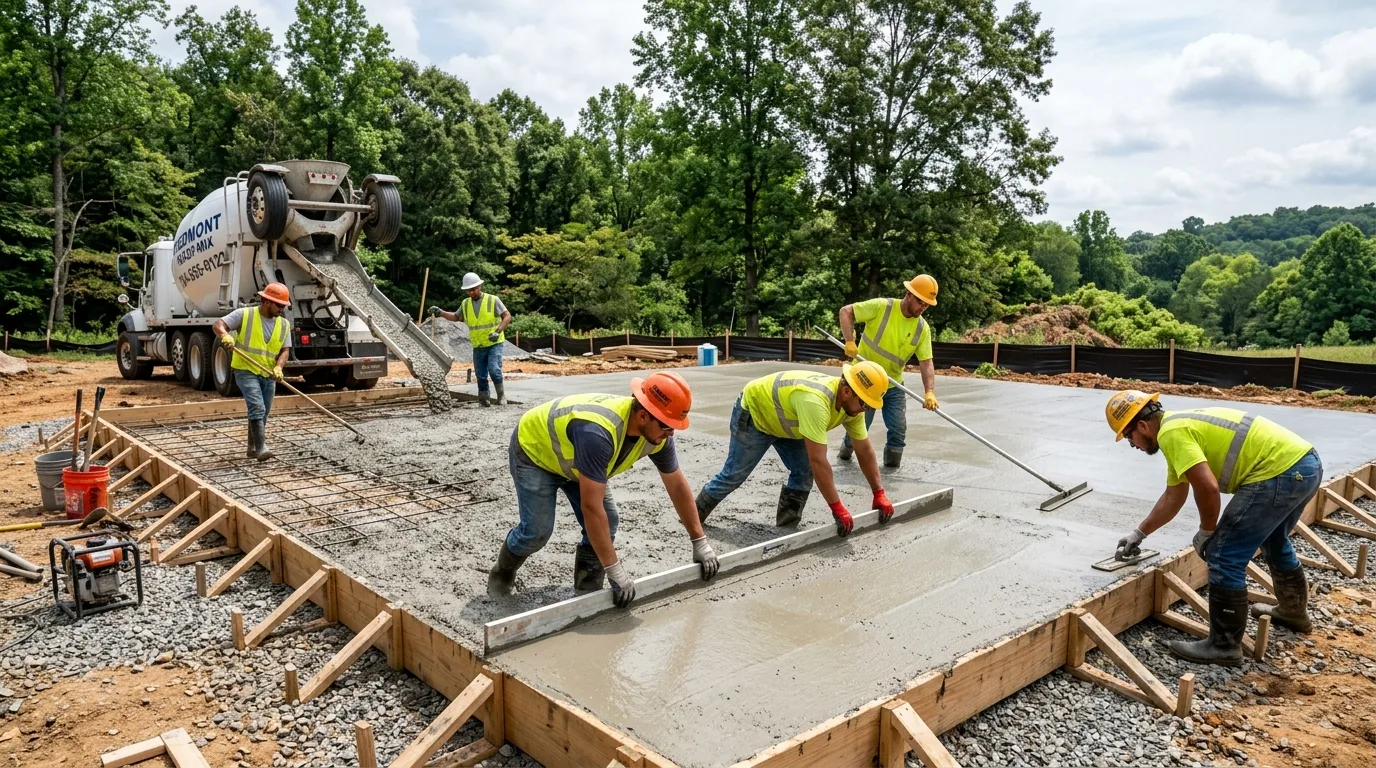
Concrete slabs are the foundation of Monroe’s most common residential projects: detached garages, backyard workshops, shed pads, HVAC equipment pads, sport courts, and outbuilding floors. Whether you’re adding a detached garage on an East Monroe lot or pouring a 12×16 shed pad on a rural Union County property, the cost drivers and local considerations are similar — but the devil is in the details of sub-base prep and thickness spec for Monroe’s red clay soil.
Get a Monroe Concrete Slab Estimate
Monroe Concrete Contractors quotes concrete slabs for all Union County residential and light commercial applications. Free estimates. Call (888) 376-0955.
Concrete Slab Cost in Monroe, NC (2026)
Monroe-area concrete slab pricing for 2026 reflects Union County labor rates and ready-mix supply pricing:
Standard 4-inch slab (residential shed/outbuilding): $5–$8 per square foot installed
Standard 4-inch garage floor with vapor barrier: $6–$10 per square foot
Structural 6-inch slab (heavy equipment, RV pads): $8–$15 per square foot
Finished/polished garage floor with color: $10–$18 per square foot
For a 24×24-foot two-car garage slab (576 sqft) — the most common detached garage project in Monroe’s residential market — expect:
- Standard 4-inch slab: $2,880–$5,760
- 6-inch heavy-duty slab: $4,600–$8,640
- Finished floor with integral color: $5,760–$10,368
Rural Union County properties in Marshville and areas east of Monroe may see modest delivery surcharges for ready-mix concrete trucks depending on plant proximity.
Sub-Base Requirements for Monroe Slabs
Monroe’s Piedmont red clay requires proper sub-base preparation under every slab — an area where inexperienced contractors and homeowner DIY projects frequently fall short. The clay that makes Union County’s soil so distinctive in agriculture is the same clay that causes improperly founded slabs to crack, settle, and heave.
Standard residential slab sub-base in Monroe:
- Excavate clay to a minimum depth of 8–10 inches below finished slab grade
- Compact the clay sub-grade with a plate compactor
- Place 4–6 inches of NCDOT #57 or #78 crushed stone and compact thoroughly
- Install 10-mil poly vapor barrier if slab is enclosed (garage, workshop)
- Set rebar or wire mesh reinforcement
- Pour concrete to minimum 4-inch depth
Homeowners who get competing quotes and see one estimate significantly lower than others should ask specifically about sub-base depth and material specification. The difference is almost always in this step.
Concrete Slab Thickness: When 4 Inches Isn’t Enough
Four-inch concrete is appropriate for passenger vehicles, lawn equipment, and typical residential storage. When the intended use changes, thickness should change:
4 inches: Pedestrian traffic, light garden equipment, residential storage, HVAC pads, small shed pads
5 inches: Standard two-car garage floor (accounts for vehicle weight and point loads from jacks)
6 inches: RV pads, boat storage, heavy trailer storage, workshop slabs with heavy machinery
6–8 inches: Small farm equipment pads, tractor storage, commercial light vehicle storage
Monroe homeowners adding shop space for hobbyist metalworking, woodworking, or car restoration should spec 6-inch concrete with rebar (#4 bars at 12 inches on center in both directions) rather than wire mesh. The added cost — roughly $1.50–$2.50 per square foot more than wire mesh on standard slab pricing — is well worth the added structural capacity.
Need a Heavy-Duty Monroe Slab?
Monroe Concrete Contractors specs slabs for the actual intended use — not just the minimum. Free estimates for all Union County projects. Call (888) 376-0955.
Edge Details That Protect Monroe Slabs from Clay Movement
Two edge details make a significant difference in Monroe slab longevity:
Monolithic thickened edges: Instead of a uniform 4-inch slab that runs to a thin edge at the perimeter, a properly built Monroe slab thickens to 8–12 inches at the edges, creating a footing that sits below the most active clay zone. This distributes perimeter loads and resists the edge-lifting that Monroe’s clay produces when it swells seasonally.
Perimeter drainage: A 4-inch perforated pipe in a gravel-filled trench around the slab perimeter captures runoff and subsurface water before it saturates the clay sub-base beneath the slab. This is particularly valuable for Monroe garage slabs where roof runoff concentrates at the eaves directly above the slab edge.
Many Monroe concrete contractors include thickened edges as standard — confirm this when comparing quotes. Skipping it saves $200–$400 upfront; repairing edge cracking from clay heave costs considerably more.
Slab Applications for Rural Union County Properties
Monroe’s rural and semi-rural character means concrete slabs serve agricultural and hobby-farm applications that suburban markets don’t see as often. In eastern Union County around Marshville and rural tracts south of Monroe:
Farm equipment pads: Tractor storage and implement pads benefit from 6-inch concrete with #4 rebar — equipment weight and point loads from hydraulic lift feet are hard on standard residential slab specs.
Livestock shelter pads: Concrete pads under cattle and horse shelters need proper drainage slope (1–2% minimum) and a rough broom or exposed aggregate surface for hoof traction. Smooth slab finishes are dangerous for livestock.
Well house and pump station pads: Small enclosed pads for well pressure tanks and ag irrigation pumps require a vapor barrier and waterproof concrete mix to resist ground moisture infiltration.
Frequently Asked Questions
How much does a concrete garage slab cost in Monroe, NC?
A standard 24×24-foot two-car garage slab (576 sqft) in Monroe costs $2,880–$5,760 for a 4-inch slab with proper sub-base preparation. Heavy-duty 6-inch slabs for vehicle hoists, heavy tools, or RV storage run $4,600–$8,640 for the same footprint. These 2026 Monroe-area rates reflect Union County labor and ready-mix supply costs.
Do I need a permit for a concrete slab in Monroe, NC?
Slabs that support a structure (garage, workshop building, shed over a certain size) require a building permit in Monroe and Union County. Freestanding pads with no structure above (HVAC equipment pads, sport courts, parking areas) typically don’t require a permit, but confirm with the Monroe Permit Center or Union County Building Code Enforcement before starting. Read our full concrete permit guide for Monroe for more detail.
How long does a concrete slab last in Monroe, NC?
A properly installed concrete slab — adequate sub-base for Monroe’s clay, correct thickness, proper reinforcement, sealed edges — lasts 30–50 years with minimal maintenance. Surface scaling, edge cracking, and mid-slab settlement are signs of a slab that was under-specced for Monroe’s conditions. Regular sealing (every 3–5 years) extends surface life and reduces moisture infiltration.
Ready to Pour Your Monroe Concrete Slab?
Free estimates for garage floors, shed pads, workshop slabs, and equipment pads throughout Monroe and Union County. Call Monroe Concrete Contractors at (888) 376-0955.
Related: